


Shadow AI: The Hidden Tools Your Employees Are Already Using
They were only trying to help…

You don’t discover it during an audit. You discover it on a random Tuesday.
An employee — smart, curious, trying to help — has built their own AI model using open‑source APIs. They trained it on internal documents. They deployed it somewhere you can’t see. And now nobody knows where your data lives, who has access, or what the model is doing.
Shadow AI isn’t a rumor. It’s already inside your organization — and it’s multiplying.
The New Reality Leaders Keep Underestimating
Most leaders still imagine Shadow AI as someone quietly pasting a paragraph into ChatGPT.
But 2026 changed the game.
Employees aren’t just using unauthorized AI tools. They’re creating them.

It starts with frustration:
A process is too slow. A tool is too rigid. A workflow takes too many clicks.
So an employee grabs an open‑source model, connects a free API key, feeds it a few internal files “just to test,” and suddenly they’ve built a private AI system running on their laptop, their cloud account, their personal identity.
No governance. No logging. No retention control. No visibility.
And this isn’t rare — it’s normal.
Shadow AI = 1,550+ unsanctioned AI apps + personal accounts + browser extensions + autonomous agents.
This is the default operating condition of the modern workplace.
Where the Shadow AI Wheel Starts Spinning
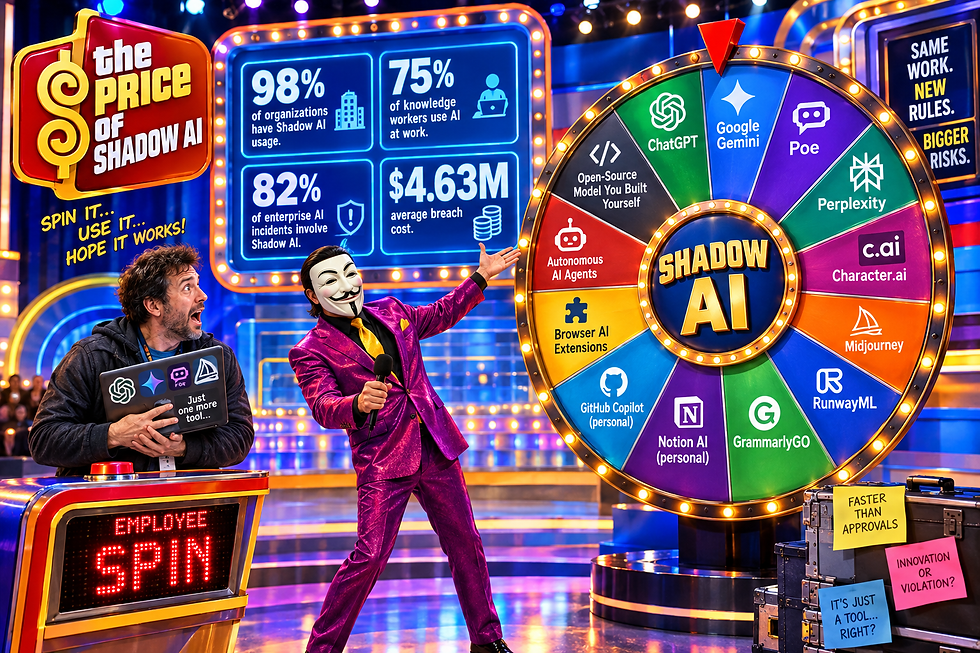
The scale is staggering:
98% of organizations have Shadow AI usage (Reco AI, 2026)
75% of knowledge workers use AI at work (Microsoft/LinkedIn)
82% of enterprise AI incidents involve Shadow AI (IBM)
$4.63M average breach cost when Shadow AI is involved (IBM)
Shadow AI isn’t “employees being sneaky.” It’s employees trying to survive the pace of modern work.
And the tools they use — or build — are everywhere:
ChatGPT (OpenAI)
The #1 Shadow AI tool globally. Cyberhaven found 11% of all content pasted into ChatGPT is sensitive, and 39.7% of all AI interactions involve sensitive data.
Google Gemini
Embedded in Chrome, Gmail, Docs, Android. Employees use personal Google accounts — meaning zero enterprise governance.
GitHub Copilot (Personal Accounts)
Developers paste proprietary code into Copilot using personal GitHub logins. Enterprise controls don’t apply.
Midjourney
Employees upload internal brand assets, product images, and confidential visuals.
Personal SaaS GenAI Apps (1,550+ distinct apps)
Netskope found 1,550 unsanctioned GenAI apps in the average enterprise environment. Examples: Poe, Perplexity, Character.ai, Replika, Jasper, Writesonic, Notion AI, GrammarlyGO, RunwayML, ElevenLabs.
Browser‑Integrated AI Extensions
Chrome and Edge extensions that can read:
CRM portals
SharePoint
email
ticketing systems
internal dashboards
These tools have autonomous access — the exact risk Aona AI warns about.
AI Agents (Unapproved)
2026 is the year of agentic AI. Employees install agents that can:
browse the web
read/write emails
run scripts
access cloud storage
perform multi‑step workflows
This is Shadow AI with autonomy.
Personal Accounts on Enterprise Tools
Microsoft Copilot, Google Gemini, GitHub Copilot, Notion AI, Canva AI, Adobe Firefly — all used with personal accounts. Netskope found 60% of enterprise users were on personal SaaS GenAI apps.
Consumer AI Writing Assistants
GrammarlyGO, Wordtune, Quillbot, Rytr, Copy.ai. Cisco found 48% of employees paste non‑public company data into these tools.
AI Summarizers & Instant‑Answer Tools
Perplexity, You.com, Arc Search, Brave Summarizer, Opera AI Sidebar, Bing Copilot (personal Microsoft account).
This is not fringe behavior. This is the modern workplace.
The Misalignment Driving the Shadow AI Surge
The instinct is to clamp down — block tools, restrict extensions, tighten controls.
But that’s treating the symptom, not the cause.
Shadow AI isn’t a technology problem. It’s a workplace design problem.
Employees build or adopt Shadow AI because:
approved tools are too slow
processes are too rigid
policies are too confusing
innovation feels gated
leadership underestimates how resourceful people really are
Shadow AI is a signal — a bright, flashing indicator that your people are trying to work in a future your organization hasn’t caught up to yet.
The solution isn’t fear. It’s alignment.

Give employees AI tools powerful enough to replace the ones they’d build themselves. Make safe AI the fastest option, not the most bureaucratic.
Teach them what “sensitive data” actually means — with real examples. Create a culture where innovation isn’t something employees have to hide.
Shadow AI shrinks when employees stop needing it.
Who Will Make the Best Calls to Thrive?
Shadow AI isn’t employees going rogue. It’s employees trying to move faster than the systems around them.
You can treat it like a problem to block, or you can treat it like a signal — a sign your organization is ready for a safer, smarter AI strategy that matches how people actually work.
The companies that thrive won’t be the ones who fear Shadow AI. They’ll be the ones who finally see it.


Comments